Rainfall

Seasonal Rainfall Outlook: August-October 2026 (ASO)

Issued: 31 Jul 2026

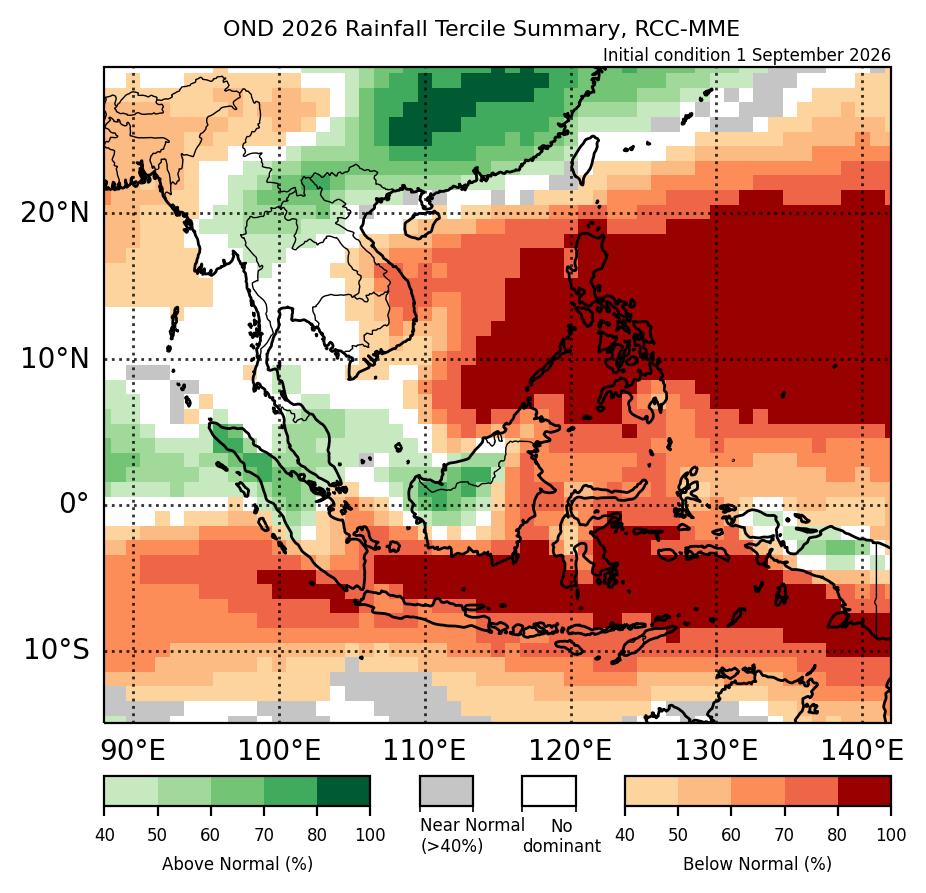
For ASO 2026, models predict below-normal rainfall for most of the ASEAN region. 

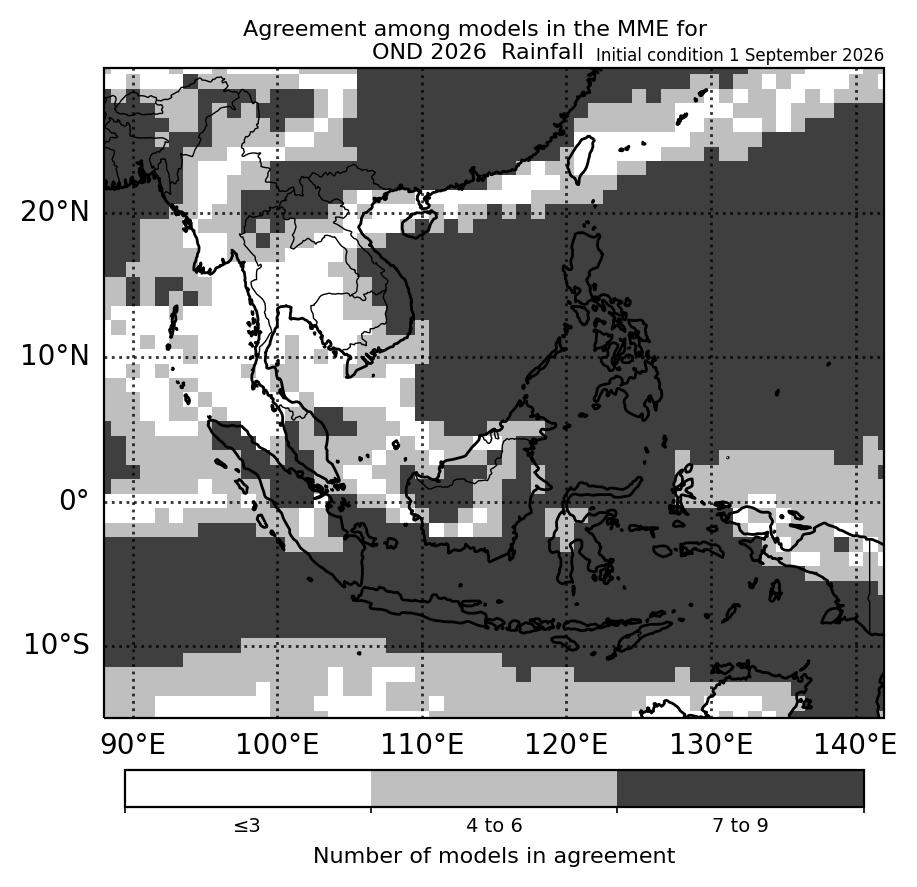
For ASO 2026, an increased chance of below-normal rainfall is predicted for most of the southern ASEAN region, in particular over the eastern, central, and southern Maritime Continent region, while and above-normal rainfall is predicted over parts of the northwestern Maritime Continent based on the multi-model ensemble (Figure 1). Most models (more than six models) are in agreement with below-normal as the dominant tercile for much of the region. Model skill is good over the eastern and central region and low to moderate over the western part at this time of the year. 

For the northern ASEAN region, below-normal rainfall is predicted for much of the region, apart from the northeastern parts where a mix of below- to above-normal tercile is predicted. Most models (more than 6 models) are in agreement regarding an increase in chance of below-normal rainfall over regions of higher likelihood predicted, with little to some models in agreement elsewhere. Model skill is low for both below- and above-normal rainfall, apart from over southern Mainland Southeast Asia, where skill is low to moderate. 
icon
Figure 1: Rainfall tercile summary predictions of the multi model ensemble for ASO 2026 (contains modified Copernicus C3S information).
icon
Figure 2: Number of models in agreement in the multi-model ensemble for the dominant tercile for ASO 2026. Where there no dominant tercile, it refers to the number of models with near-normal tercile (contains modified Copernicus C3S information).
icon
Figure 3: Average climatological rainfall's lower tercile boundary for ASO based on CHIRPS (Reference period: 1991-2020).
icon
Figure 4: Average climatological rainfall's upper tercile boundary for ASO based on CHIRPS (Reference period: 1991-2020).

The qualitative outlook is assessed for the region in general. For specific updates on the national scale, the relevant ASEAN National Meteorological and Hydrological Services should be consulted.