A
A
A
The content is loading
Period:
This page considers the ENSO outlook for the next three to six months, and the typical impact of El Niño and La Niña events on rainfall in Southeast Asia.
Current SST conditions using the traditional Nino3.4 can be found on the climate monitoring node website: sst - SEA Climate Monitoring
Updated: May 2026
Recent sea surface temperature anomalies over the equatorial Pacific Ocean during April-May 2026 overall indicated ENSO neutral conditions were present. However, persistent warming over most of the Niño regions, together with atmospheric indicators such as decreased cloudiness over most parts of Southeast Asia and anomalous low-level westerlies east of the Philippines, support the development of El Niño-like conditions. Meanwhile, the Indian Ocean remains in a neutral Indian Ocean Dipole (IOD) phase.
International climate outlooks predict a moderate El Niño is likely to develop during June to August (JJA) 2026. After JJA, most models predict continued strengthening into a strong to very strong El Niño, while the rest predict only moderate El Niño conditions to persist through the remainder of the year. If a very strong El Niño occurs, this does not necessarily indicate bigger impacts on Southeast Asia’s climate but rather that typical impacts from El Niño events are more likely to occur. The IOD is also predicted to transition to positive IOD conditions through the latter part of 2026, although with less confidence than the predicted El Niño.
Model outlooks from Copernicus C3S (Figure 1), based on the Relative Nino3.4 SST index, predict the El Niño conditions to continue strengthening until October – November 2026. Most models predict the El Niño conditions to begin to weaken in December 2026 – January 2027, although to still be above the threshold for strong conditions (1.5°C) in early 2027.
Figure 1: Forecasts of relative Nino3.4 index’s strength until February 2027 from various seasonal prediction models of international climate centres (image credit: Copernicus C3S).
The typical impact of El Niño on Southeast Asia is drier-than-average rainfall conditions, including for much of the Maritime Continent during December to February (Figure 2, left). Warmer temperature conditions typically follow drier periods. The opposite conditions for rainfall (and consequently temperature) are observed during La Niña years (Figure 2, right).
The impact on the region’s rainfall and temperature from ENSO events is more significantly felt during strong or moderate-intensity events. Also, no two El Niño events or two La Niña events are exactly alike in terms of their impact on the region.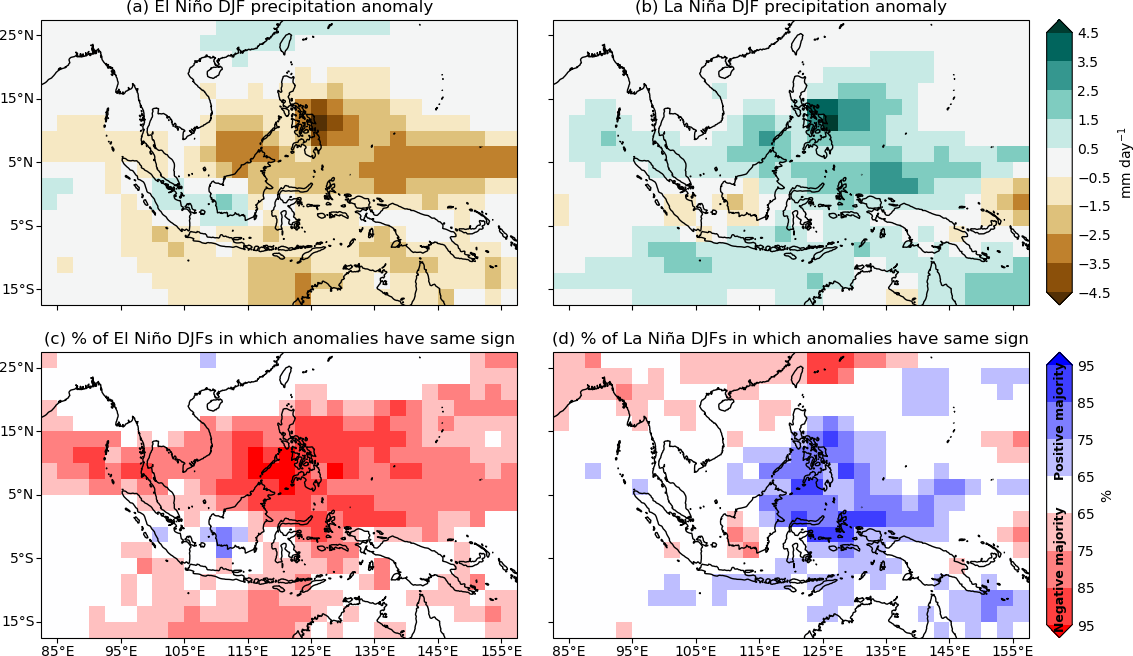
Figure 2: December to February (DJF) season rainfall anomaly composites (mm/day) for El Niño (top-left) and La Niña (top-right) years. Brown (green) shades show regions of drier (wetter) conditions. Corresponding percentage of events for El Niño (bottom-left) and La Niña (bottom-right) in which the anomalies have the same sign as that of the anomaly composites.
Note that this anomaly composite was generated using a limited number of El Niño and La Niña occurrences between 1979 and 2021 and therefore should be interpreted with caution (data: The Global Precipitation Climatology Project (GPCP) Monthly Analysis Version 2.3).
The qualitative outlook is assessed for the region in general. For specific updates on the national scale, the relevant ASEAN National Meteorological and Hydrological Services should be consulted.